Today, both Canada and Germany are balancing efforts to maintain their manufacturing sectors, compete in the global trading environment, and build toward the economy of the future. One industry underpins these three fronts: the battery industry. It is essential for future clean tech manufacturing, including electric vehicles, and can support each nation’s capacity to increase sovereign control over domestic energy systems. The capacity to build battery and battery materials value chains, interlink them with those of our allies, and develop supportive and interconnected battery innovation ecosystems should be a goal of industry and government in Canada and Germany. Following some conversations with our colleague Stefan Wolf at KLiB, the German association of industries and research facilities along the value chain for lithium-ion batteries, we want to generate some thinking in our network on Canada-Germany battery industry collaboration and development.
While battery ecosystems in both nations are inherently linked to the automotive sector, batteries are a key technology for countless industries, from power tools to medical devices, from mobile robots to drones, and from renewable energy systems to defence technology. Therefore, it is of the utmost importance for both countries to establish a resilient battery supply chain. Looking at respective priorities and emerging opportunities, we can compare them and put forward some recommendations on further connecting the German and Canadian battery ecosystems.
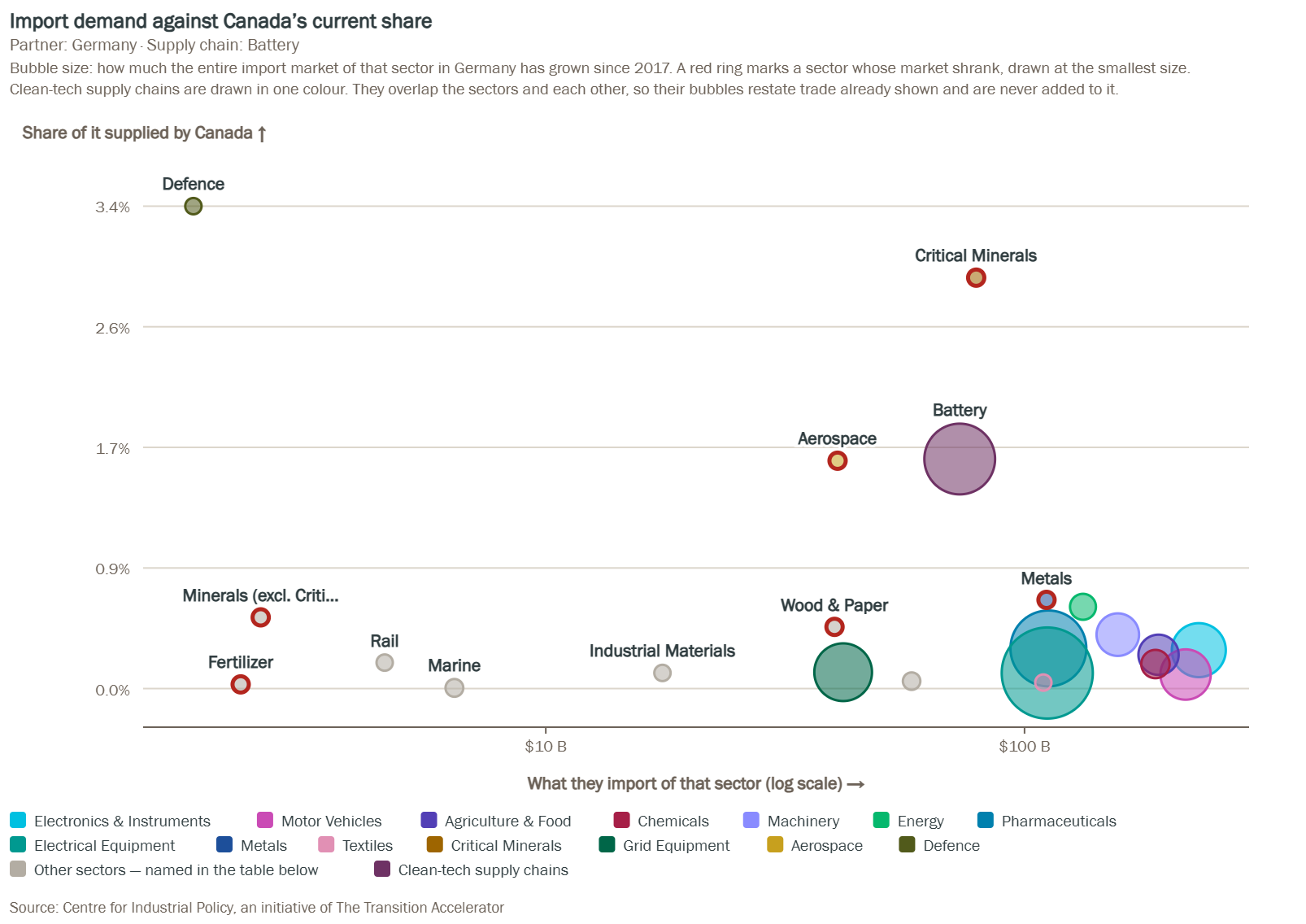
The Figure below taken from the Transition Accelerator’s Center for Industrial Policy shows Import demand against Canada’s current share of the Market. Each bubble is one sector.
Two things are read at once: how much Germany imports of that sector, and how much of it comes from Canada. The bottom right corner is where Germany imports a great deal and Canada supplies almost none of it. Horizontal → what Germany imports of that sector in a year, from every supplier in the world, not only from Canada. Vertical ↑ how much of those imports Canada supplies. A sector sitting at 0.5% means one dollar in every two hundred Germany spends there comes from Canada. Bubble size how much the entire import market of that sector in Germany has grown since 2017. The size is the scale of the growth and a red ring marks a sector whose market shrank instead.
Fig.1. Import demand against Canada’s current share. Each bubble is one sector.
Canada has traditionally looked for opportunities higher upstream in the battery value chain, at the mineral extraction level. Building true resiliency requires more midstream capacity, leveraging our clean power and innovation advantages. As Canada looks to advance the development of its battery industry in concert with partner nations like Germany, here are some potential areas of focus:
Building LFP CAM Supply — While NMC chemistries have dominated the EV market, as we look to the future, there is an opportunity for Canada to stake a claim in global LFP materials supply. Canada’s Nano One Materials has developed a world-leading process to produce LFP CAM more efficiently and to the high environmental standards that would meet Germany’s and Europe’s needs. In September, the company launched a new development company to organize suppliers, with the aim of getting 25–100 ktpa of cathode production online. Fortunately, Canadian minerals could be positioned to feed in here. With German cell producers increasingly looking at LFP production, including German company IBU-tec’s new LFP calcination process, there is a strong opportunity here.
Going further up the chain — In August, Canada and Germany signed a joint declaration on building lithium and other raw materials supply chains. Canada has leading projects, in both hard rock and DLE, that are ready to move in the next few years. German investors have already taken an interest here, with Canadian-backed Rock Tech Lithium building a conversion plant in Germany and a TKMS-E3 Lithium agreement signed in April. If Canada moves on the first third of the lithium supply chain, there may be emerging capacity for Germany to take the ball the rest of the way. Refining capacity in both nations is still lacking, but new joint ventures and partnerships could help overcome this hurdle and create a stable base for production across multiple battery chemistries.
Interlinking the innovation ecosystems — Canada’s government has been investing in and supporting the national labs and battery innovators across the country. The National Research Council’s Battery Value Chain initiative and self-driving materials discovery lab in Mississauga, ON, are working to align the next breakthrough in battery materials discovery with Canada’s mineral strengths. Programs like the NRC IRAP are supporting companies as they build from early to mid TRL and prepare to demonstrate their processes for validation, production, and processing.
Germany, meanwhile, has recently launched new vertical application alliances to develop new battery technologies in a product-driven way. Combined with the Fraunhofer Research Institution for Battery Cell Production (FFB) in Münster, this is building out innovation and scaling capacity. Onboarding Canada into the German BecoSearch database will be a clear next step to begin integrating these two innovation ecosystems. Going forward, working to integrate these mapping and database efforts with Accelerate partner BMAC’s ecosystem map will support information flows and ecosystem knowledge in both countries.
In the above, we have highlighted some of the opportunities that lie before Germany and Canada in terms of interlinking and advancing their battery ecosystem ambitions. Following the EU-Canada business summit, here are some ways to keep moving forward: actions that will support these opportunities and help find and build new ones.
Launch a Bilateral Critical Materials Offtake & Price Stabilization Facility: Building on the Germany-Canada agreement and strengthening ties between Canada and the EU more broadly, Export Development Canada (EDC), the European Investment Bank (EIB), and member-state development institutions should explore a bilateral group to scope a joint credit guarantee mechanism. Focusing on the midstream of the battery materials supply chain, this group would develop financial proposals that will de-risk long-term supply contracts between miners, processors, and cell producers on both sides of the Atlantic.
Establish a Joint Working Group on Regulatory & Battery Passport Interoperability: We know that new requirements under the EU’s battery regulation are coming into effect next year, and there is a need to support Canadian suppliers in meeting battery passport requirements. A joint working group with representatives from key government and industry actors in Canada and Europe could quickly establish reciprocal compliance standards for carbon accounting, mineral traceability, and ESG certifications.
Fund Co-Innovation Calls in Next-Generation Battery Technologies: Canada’s recent association with the Horizon Europe program and our shared history of innovation in battery value chains create an opportunity to increase joint research. This could include allocating dedicated co-funding through Horizon Europe and Canadian research networks to target midstream processing, black mass recycling, extraction or validation tech, and materials synthesis.